
In my last post, I promised more details about how I organized the Tickled Pink spin. I usually opt for spinning projects that require the least possible degree of thought and organization. As a result, Tickled Pink has been quite the learning experience.
The fiber arrived wrapped up in three separate balls with distinct color blocks. Each ball weighed about 50 grams. My plan seemed simple enough: split each color into six lengthwise strips of about 8.3 grams each. In reality, I struggled to accomplish dividing them into halves, much less sixths.
I resorted to breaking the color blocks into crosswise sections of equal weight, rather than lengthwise ones. With this project, the color was relatively uniform within each ball—the gradient was formed across the balls, not within them—so dividing by weight was easiest. If the colors varied more within each ball, I would have divided them by color instead.

During this process, I learned that my kitchen scale is inaccurate with small weights, and tenths of grams. I may need to upgrade to better equipment before my next complicated spin attempt.
Once divided, each color section weighed about seven grams: six hot pink, six medium pink, and six white. I used the leftovers from each to create transition zones between color blocks. A small amount of hot pink and medium pink, for instance, could be blended together to smooth out the progression from darker to lighter colors.
Here you can see the color chunks arranged like the three separate plies of the final yarn.

For comparison, here is the original graphic visualization I created for the previous post.
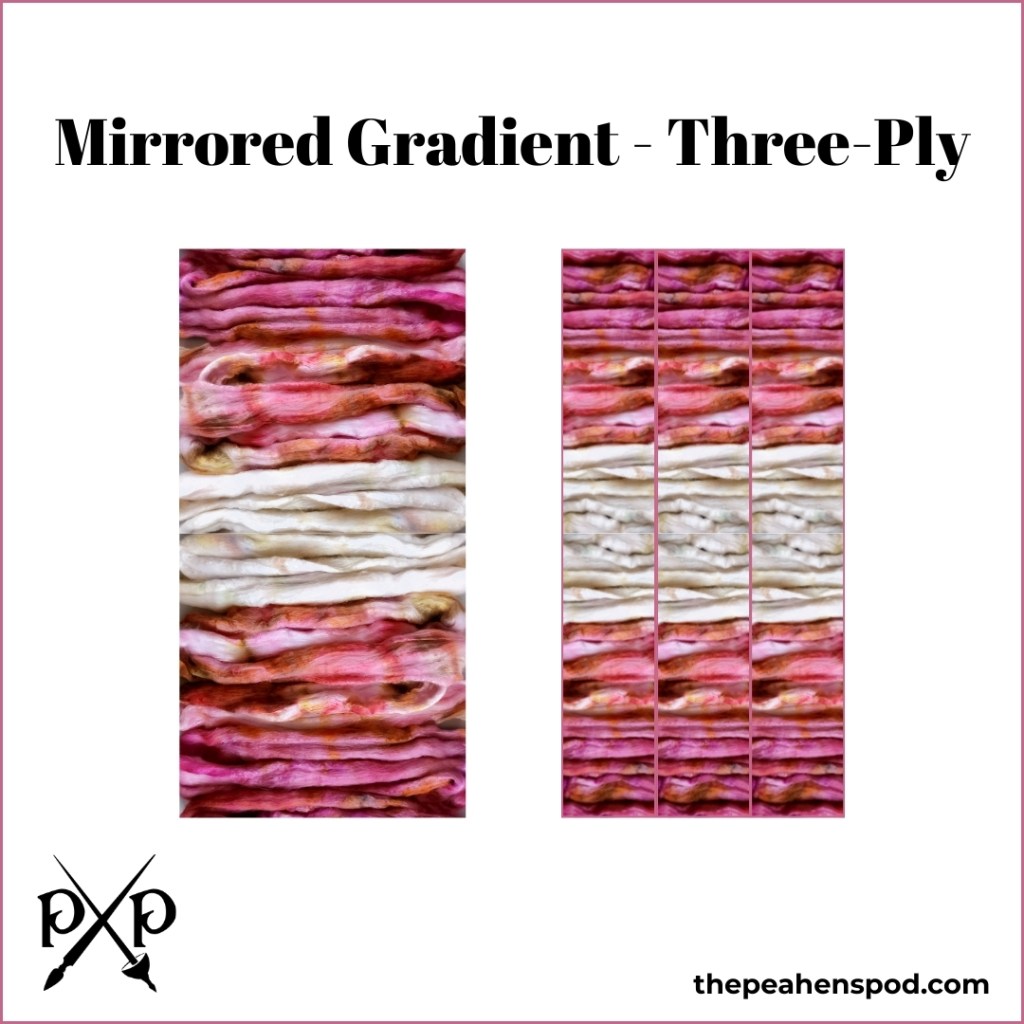
The fiber looks like my original plan—a good sign!
Next question: how do I keep track of nine pieces of fiber that need to be spun in a specific sequence to form each ply in a three-ply yarn?
I’d developed a Spinning Planner Card for my Tour de Fleece 2023 spin, but that followed a simpler approach. For that two-ply yarn, there were only eight sections—four per ply—assigned to eight supported spindles. For each section, the card reminded me which spindle to use and which end of the fiber to start spinning first.
In the Tickled Pink spin, by contrast, I needed to track 27 separate chunks of color! I opted to cut scrap paper labels and wrote on each the following information:
- Which singles: one, two or three
- The color chunk name: hot pink, medium pink, white, or one of the blends
- For the pinks, whether the chunk was “one” or “two,” since each color repeated twice (I treated white as one single large section in the middle)
- Spinning start and end date
This left a small space on the label for any notes.
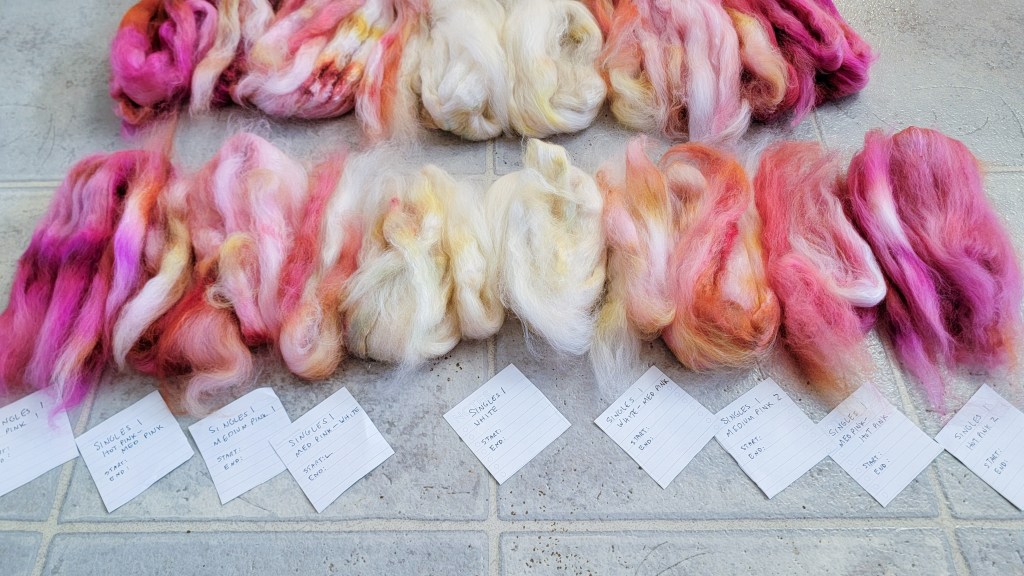
Each label gets stuffed, with its corresponding fiber, into a reclosable plastic bag. As I complete each bag’s worth of floof, its label (and any that proceeded it) migrates to the next bag. Accumulating labels into the current bag has already saved me once from spinning a section out of order. I had two bags packed for a road trip, and accidentally plucked out wrong one when I settled in for spinning during the car ride. I could immediately tell and correct my mistake, because the bag had only one label instead of several.
An even larger bag then holds each group of nine colors that makes a singles yarn to keep them bundled up together. Otherwise I would have to sort through 27 bags with six possible matches (for example, if I was hunting medium pink) and check the label on each one to be sure I had the correct color to spin next.
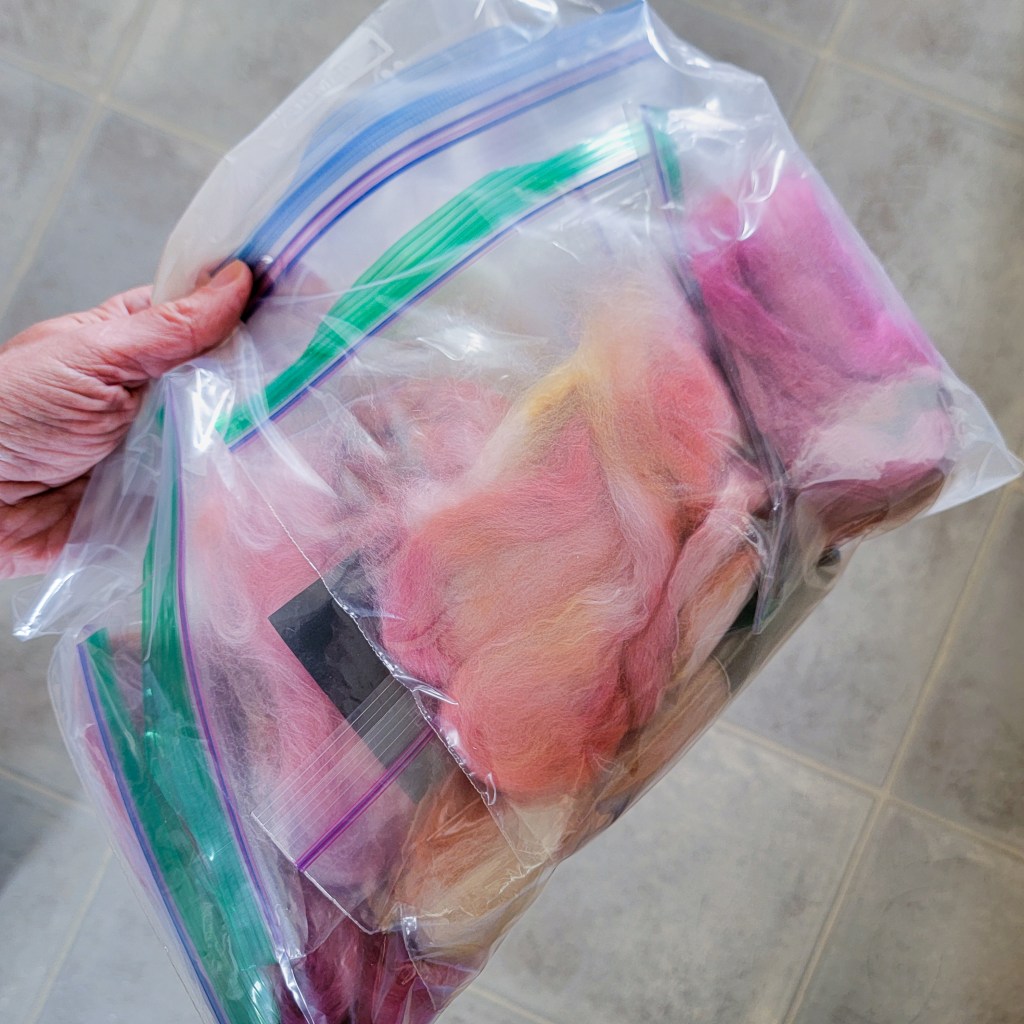
Overkill? Maybe.
Would it matter which medium pink I actually plucked from the pile when it was time to spin that color? Possibly not.
The three piles of fiber—nine chunks for three plies—each ended up weighing different amounts. They should have been about 50 grams each, same as the original three balls. But human error crept in during the chunking process. If the weights had been even between the three, picking the wrong medium pink could have added more fiber, and hence the spun yardage, to one singles yarn versus the others.
In reality, the three plies will be different lengths anyway due to my own inconsistent spinning. Even when using a spinner control card (a habit I need to resume), the thickness of my spun yarn varies greatly depending on my energy levels and attention to the task.
All this to say, I’m carefully organizing the fiber for my own peace of mind, rather than for the quality of the yarn I create. Organization keeps the 27 plastic bags easy to locate, saves me time tracking down the next color to spin, and lets me easily see the progress I’ve made.
How is the spin actually going? More on that in another post!
 The Peahen's Pod